

Every addict says they've got a book in them. Oh, the stories they could tell.
And certainly, crack offers a devastating narrative. But many of these stories share the same problem: they rarely offer meaning. And people trapped in active addiction often have a hard time finding wisdom in their suffering.
Instead, stories become a kind of exaltation in the past. (See: Sheen, Charlie)
Or else, it’s the same series of extraordinarily sad stories — with every addict’s experience joining the same tapestry of tragedy.
Now, who wants to read that book?
Well, I am writing a book. It started very badly. I remember sitting on a bed in a rented room with a laptop at my fingertips. Only my fingers couldn’t receive the signal. They just loitered around the keys — mostly the Backspace button.
Let’s see: Memoirs of a Crac— No, no.
How would I begin this book, anyway? I hadn’t slept in days. There was nothing on my mind, save for a growing urge to scrape resin from the pipe on the night table.
A few days later, I took the laptop to a downtown alley, and traded it for a fistful of dope. I couldn’t write anyway. I couldn’t even live.
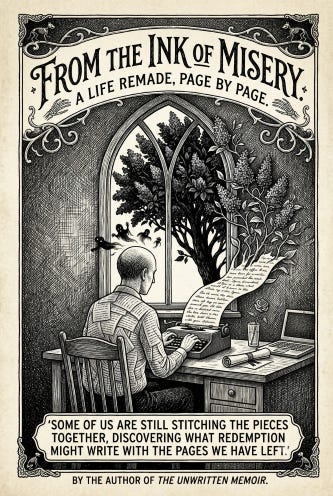
I found a way out of that place just before the story with no beginning reached a very bad ending. I found a desk at my mother’s house, overlooking a lilac tree. At first, I fumbled for sentences. My mind was flooded with memories — none of them good, and all of them keeping me awake at night. But as that cold winter passed and the flowers bloomed, something in my mind began blooming too.
I enrolled at the local university.
I wrote my first essay, my fingers dancing over the keyboard, possessed. Whole entire sentences! It felt like a new drug. Now, I’m writing to get high. It’s a strange kind of intoxication — one that gives something back.
Writing a book helps me imagine my experience as an unlikely gift — one that might give me what we spend our entire lives seeking: wisdom.
If I do gain wisdom from this catastrophe, I want to share that gift with you — without you having to go through the inconvenience of being a miserable, broke-ass junkie.
Maybe writing could make room for a conversation less trapped in the same old stories — one that is more compassionate and less dangerous.
At least, maybe addicts and their families will feel a little less alone.
Finally — maybe most importantly — I’m trying to nail the ending.
I learned about endings when I had a job writing sad stories about animals that needed help. They were being poached into extinction or needed a loving home or being forced to fight each other. I could never promise my reader a happy ending.
How could I — while still being honest? We’re devils to animals.
My editor came up with a workaround. Give the reader the power to make their own ending. And how would they do that?
Well, every animal story I wrote ended with a tag line at the bottom. Something like: ‘If you think you might be able to provide a home for the loneliest dog in the world, reach out to the so-and-so humane society.’
Or, ‘If you think the owners of Seaworld are evil bitches who are brutalizing beluga whales to make a buck, write to your local congressman today.”
It’s called a ‘Call to Action.’ It gives the reader somewhere to put their grief besides helplessness. Think about it: if the stories always ended along the lines of, ‘We’re fucked,’ would you keep reading?
When I listen to the tales we tell about addiction, I often hear the same message: ‘You’re fucked. I’m fucked. The world is fucked.’
When I listen to people in recovery, on the other hand, I hear the same words — only in the past tense. There’s still lots of drama in a recovering addict’s story. The end is never assured. Will the addict really stick the landing? There’s delicious uncertainty in that.
It’s hard to answer the fundamental question every survivor eventually faces: What was it all worth? Not why did it happen. Not how did I escape. But whether something beautiful can grow from something that nearly destroyed me.
It’s also got my favorite element in any story: a redemption arc.
I don’t know what the final chapter of my book will say. I don’t know if I’ll get the ending I’m hoping for. That’s the terrifying and wonderful thing about recovery: the story is written in moments, not chapters.
We are all made of pages. But not all of us are books.
Some of us are still stitching the pieces together, discovering what redemption might write with the pages we have left.
....joining the same tapestry of tragedy. I often re-read some of your sentences, because they feel like art. Thanks for the blog.
You're not only a fantastic writer, but such an empathetic teacher. I could really see you helping former addicts write their own life stories in their own words. I often think if you've truly recovered, that your story is grounded in truth. I think you'd be amazing at helping people share their truths. And grow a movement of empathy and understanding.