


My mom was shaving her chin the other night and talking about her ‘third eye’ and an approaching comet, when it occurred to me just how much she’s changed over the last year.
And before you get prickly about my inclusion of this very personal detail about her, know that she has given me explicit permission to describe her beard. She may even be a little proud of it.
I wouldn’t even call it a beard, really. Just one or two thick white—
“No, no,” my mom interrupts, while I’m reading the above passage for her approval. “Don’t give it all that. You don’t want people to think you’ve got some kind of freak mother.”
Later, she’d say, “The eloquence of how I think compared to the eloquence of how I speak is like night and day.” And I would dutifully write it down.
Anyway, the only reason why I mention her ‘old-lady-o’clock shadow’ is because it’s constantly pricking me.
Because she’s constantly hugging me.
I guess she’s always been wise. I just wasn’t paying attention. Too busy getting high in the abandoned warehouse of my own mind.
When I went clean, I moved back home. You might think a man fresh from a long and feverish drug habit living with his mother would make for a rather combustible situation. And sure enough, in the early days, the tiniest of frictions threatened to take a match to the situation.
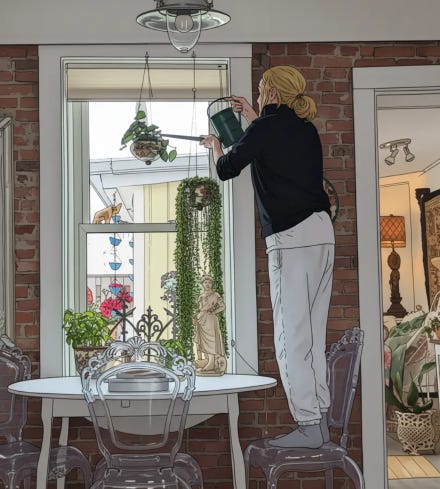
But as time went on, we got close. Not in the Norman Bates–ian sense. It’s more like a couple of plants mutually agreeing to water one another.
Probably for the first time since I was a kid, I can actually hear her.
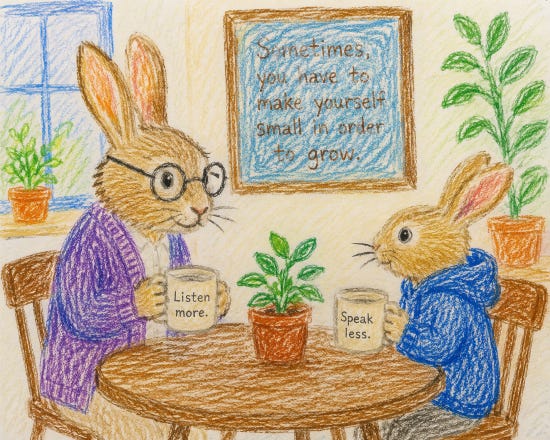
Listening — really listening — makes you feel smaller. In a good way. It allows space for others to exist in, and reminds them that their voices are valued and their perspective is considered. You wouldn’t believe the things I learned from truly listening to the same old people I thought I’d squeezed dry decades ago.
Sometimes, you have to make yourself small in order to grow.
When I first sat around a table with addicts at a Narcotics Anonymous meeting, I had so much to say. My turn! My turn! Hand me the conch shell, already. I wanted to talk about my experiences as a druggie — my frustrations and disappointments and misadventures and how I ruined my life worse than yours.
But I had to wait patiently for everyone else to tell their inferior tales of woe. Eventually, their words — no, I guess the feelings behind them — began to sink in.
When it was my turn to speak at meetings, my stories got shorter. They didn’t seem so important anymore. Everyone knows suffering. Mine isn’t exceptional. Besides, I can’t learn a thing from my own tales of woe — only those of others.
Then one day, it was my turn to speak at a meeting. And all I could do was pass along the conch shell.
Love this. So beautiful and well written.
Cannot get over the old lady o'clock shadow. You don't expect to read that someone's Mom was shaving their chin the other night😄