


“Nobody will laugh long who deals much with opium: its pleasures even are of a grave and solemn complexion.”
~ Thomas de Quincey
For the last 20 years or so, I’ve been a little guarded about my identity as a drug addict. Being a former journalist at the biggest newspaper in Canada doesn’t easily reconcile itself with an addiction to crack cocaine. At least, not when it comes to one’s precious reputation.
If I was going to be even vaguely employable, I’d have to find a pen name to write about addiction and recovery.
I settled on De Quincy.
It harks back to a time before things went terribly wrong, when I was an English literature student — addicted only to very old books. In one of my classes, we took a deep-dive into a most singular work: Confessions of an English Opium Eater by Thomas De Quincy. Its impact on me was profound.
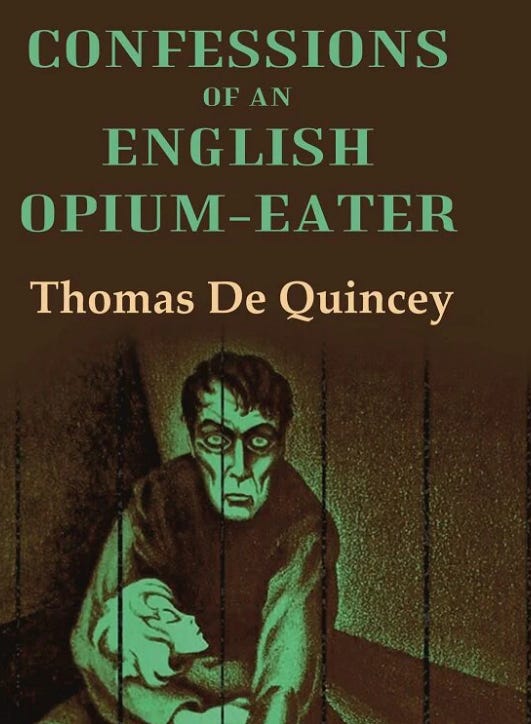
When published in 1821, this fanciful account of De Quincy’s all-consuming opium habit was all the rage. And I mean, rage. This was the Regency period, after all – at the cusp of the Age of Victoria. While there was never a time when being poor was a riot — unless it was a literal riot — the Regency period, by all accounts, was a particularly painful time to be alive and impoverished.
In the face of the most miserable living conditions — with entire families commonly on the streets – the upper classes had a simple justification for all that inequity: Poor people needed to obey, work harder and stay sober.
Easy for the rich to say. At the time, opium was legal and immensely popular. Unable to afford a proper doctor, the poor huddled masses used opium for every possible ailment – broken bones, sleep problems, even to shut the baby up, at least for a moment. It was literally the opiate that led the poor, huddled masses.

This is the environment that Thomas De Quincy — a man of means and many vices — came out as a recreational druggie in.
Here’s what Percy Hutchison wrote about him in the New York Times back in 1936:
“Wise in many directions De Quincey undoubtedly was, and most certainly he was a trifle mad. A man who could take 8,000 drops of laudanum a day, seven wine glasses, full, could scarcely be regarded as completely sane. But the fact that De Quincey practically overcame the habit, as all who have read ‘Confessions of an English Opium Eater’ are aware, proclaims him also a remarkable man.”
Still, if you think coming out as a junkie today is a devastating revelation, try doing it in the time of King George IV.
While opium was used recreationally in De Quincy’s time – if that’s what you can call the brief respite from life’s brutalities recreational – he went full-gonzo.
Certainly, British society — like ours — couldn’t say no to a good scandal. And De Quincy’s tale was a strong cup of tea. There’s a certain Charlie Sheen-esque tone of exaltation in his sparkling verse. He likes his dope. But there’s also uncertainty and anxiety.
In the book, De Quincy even addresses the stigma attached to confessing his drug-induced misdeeds in such public fashion.
Here’s how John Strang, a professor at the National Addiction Centre at Kings College London, describes the furor that accompanied the book’s publication:
“Heated debate followed on such topics as: the causality of opiate use; self-inflicted suffering and responsibility; the impact of availability and environment; therapeutic addiction; controlled use; the emergence of dependence; tolerance; withdrawal techniques…”
It sounds like, by coming clean, De Quincy sparked a very important conversation. The trouble is, Regency, and later Victorian, England kept on locking up addicts. Or, if they were lucky, burying them in charming mental institutions.

Today’s headlines, some 200 years later, suggest we’re still carrying that torch. In June, the Ontario provincial government passed the Safer Municipalities Act. The law aims to remove homeless encampments in cities, but it leans heavily on the enforcement side. It deems people living in parks as trespassers and provides fines of up to $10,000, or six months in jail. There are more than 3,300 people in 10,000 encampments in Ontario alone.
But hold on, we’re not done yet. New legislation – Bill 6 – proposes to further prosecute anyone found consuming drugs in a public space. In this case, ‘public’ includes the inside of someone’s tent. Under this government, if they dare to be seen — imagine that, seen — servicing their habit, they could be hit with a massive fine and a criminal record.
And for a vote-grubbing encore, the provincial government is floating the idea of forcing addicts into treatment centers — despite overwhelming evidence that involuntary treatment does not work. In fact, it’s linked to more overdoses.
“Forced abstinence during incarceration places individuals at extremely high risk of overdose after release by decreasing tolerance without treating substance use disorders,” Yale professor Alexander Bazazi noted in a landmark 2020 study.
Alternately, we could try asking someone how they would like to be treated — as we would with anyone suffering any other disease. And make no mistake, addiction is a disease.
“To take away someone’s fundamental rights to make decisions about treatment, which is the integrity of their own body and their own freedom, in the absence of compelling evidence is really going very far,” Kerry Bowman, a bioethics professor at the University of Toronto, told CBC News.
Well, at least we’re making some progress in the language we use.
Instead of involuntary treatment, some Canadian provinces are using kinder terms like compassionate intervention. Way to modernize a medieval practice, Canada!
Today’s prisons probably look a lot like their Victorian counterparts too — teeming with addicts. The Canadian Centre on Substance Abuse suggests 48 percent of inmates are addicted to drugs.
They’ve already fallen into an abyss with precious few opportunities to claw their way out. As a modern, progressive society, we might suggest throwing them a rope. But instead, we dig an even deeper hole and throw addicts into it.
In Canada, decriminalization — even for a paltry amount of dope — is still bedeviled by political pussyfooting. Campaigning on decriminalization is just not a good look for a major candidate. Leave that stuff for the unelectable fringe socialists! Let the main political players forever feast on tax cuts, infrastructure projects and, of course, crime.
It seems we’re still clutching our collective pearls over the notion that addicts should be allowed a safe space to do drugs without dying quite so much. And definitely not within sight of a swingset. Think of the children! Yeah, because we want our children to grow up just like us — oblivious. And their children. And on and on and on.
So, how much have we advanced as a society since De Quincy’s seminal work? Let’s be honest. Inches. We’re the same outraged masses — only with iPhones and IMAX and Instagram.
At this rate, we’ll be extinct before we can wrap our heads around a way to treat addiction that is humane, compassionate and, actually, effective.
Let’s not place too much of the blame on ourselves. If we’re not sopping up media stereotypes or quivering under the bullhorn of self-serving politicians, our perspective is informed by personal interactions with addicts. If you’re getting accosted in the streets for ‘coffee change’ — or, maybe there’s a strong smell coming from someone on the subway, you may start leaning a little more to the ‘lock ‘em up’ approach.
Fight that feeling. It’s too easy. And it’s patently unhelpful.
What we need to do, really, is take a great leap forward — and change our own hearts and minds. When people have a disease, we allow them grace and dignity. We don’t force them to do something they don’t want to do. We certainly don’t imprison them. Those suffering from the disease of addiction deserve that grace too. And more than anything else, they deserve our compassion.
Nearly two centuries ago, De Quincey forced English society to look at an addict not as a monster, but as a man. We still haven’t learned that lesson. If compassion was radical then, perhaps it still is now. But it’s the only revolution worth having.
Fantastic read and incredibly well-written, as always. This one might be my favourite so far.
F@cking SO BE IT!