


The last recovery meeting felt different. So did the one before it.
I thought maybe if I skipped a few, I’d build more enthusiasm for sitting in a circle sharing tales of hardship and hope.
But driving home, a sad song on the radio, I turned over the same uncomfortable question in my mind.
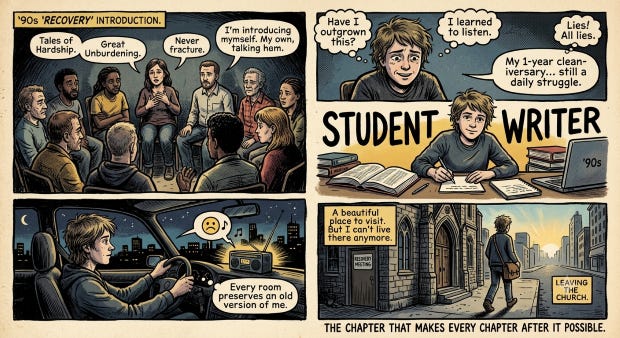
Have I outgrown recovery?
The question felt almost sacrilegious. Recovery had saved my life. It had introduced me to honesty, humility, friendship. Recovery taught me how to survive the world without going numb. It gathered people who had finally become too exhausted to lie to themselves. It was the great unburdening — a lifetime’s worth of weight set down, one confession at a time.
“They should teach this stuff in school,” one woman said.
“I wish I could drag my sister here,” rhapsodized another. “She isn't even an addict.”
So why don't more people stay there?
Meetings have a revolving cast. Someone disappears. Someone comes back. Someone starts over.

I even caught myself falling into another old habit: people-pleasing.
I was self-conscious about what I shared. I didn't want to come off as someone too recovered for these meetings. When I spoke, I touched lightly on my return to school, and low-key mentioned that I had recently marked one year clean.
I wanted to make sure everyone knew I was still one of them.
In fact, I even went so far as to say that it's still a daily struggle. Sometimes, I added, I feel like I'm just one wrong turn away from a relapse.
Lies.
All lies.
At a recovery meeting.
Sure, an ex-addict is never completely out of the woods. But I've never felt more confident in being clean.
In fact, I’m mostly reminded of my old life whenever I attend a meeting. If I have to keep visiting the ghost of my past self every Tuesday at 7:00 PM just to keep him alive, am I actually free of him?
Years ago, a doctor warned me not to spend time around slippery people. Back then I assumed he meant dealers, old friends, familiar places. I never considered that he might also mean recovery itself. Not because recovery is unhealthy. Quite the opposite. But every meeting asked me to resurrect a version of myself I’d already spent years leaving behind.
If addiction is the complete absence of growth, recovery is its opposite. Are meetings the exception — something we're never supposed to grow out of?
The struggle against our demons used to unite us. It gave me a sense of kinship with complete strangers. It began to change how I saw myself — even though it was always through the lens of addiction.
I‘d introduce myself at meetings like this:
“I’m an addict. I’m back in school, so I’m a student.”
“I’m an addict. I write, so I’m a writer.”
Friend.
Son.
Journalist.
Comedian.
Every version of myself began the same way.
But recovery isn’t the whole story anymore.
It’s the chapter that makes every chapter after it possible.
Maybe that’s what recovery was always supposed to do — not keep us in the room forever, but prepare us to leave it.
Some people will spend the rest of their lives in these rooms, and I hope they do if that’s where they continue to find their grace.
But churches are meant to send people back into the world.
I’m leaving the church.
It was a beautiful place to visit.
But I can’t live there anymore.
“I’m an addict. I’m back in school, so I’m a student.”
“I’m an addict. I write, so I’m a writer.”
I love those lines. I don't define you as an addict, I see you as someone doing incredible things with their life.
I understand how some people need to be reminded of their past, and there is value in recognizing it. But I believe we're allowed to grow and change. Our past can be part of our story without becoming the whole story.
Amen!