

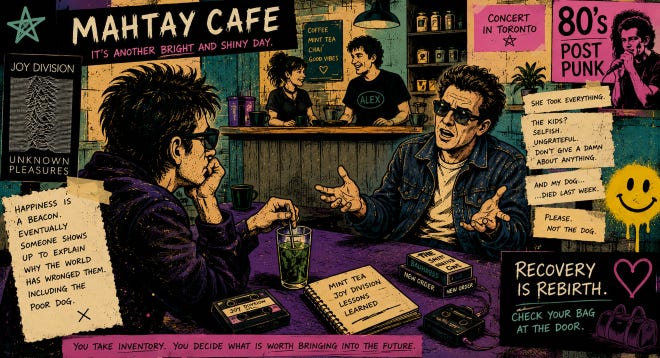
It’s another bright and shiny day at the Mahtay Cafe.
Alex and Nana are behind the counter chirping merrily about a concert in Toronto, a bit of TV, and a new apartment.
Joy Division is playing. I’m stirring a tall glass of mint tea.
And someone I knew from a long time ago — pre-addict days — pulls up a chair and dumps his whole life on me. It’s my own fault, I guess. I was looking up with a blank, cheerful, stupid smile on my face. Inviting trouble.
My old friend, whose name I don’t recall, is delighted to see me: “What have you been doing all these years?”
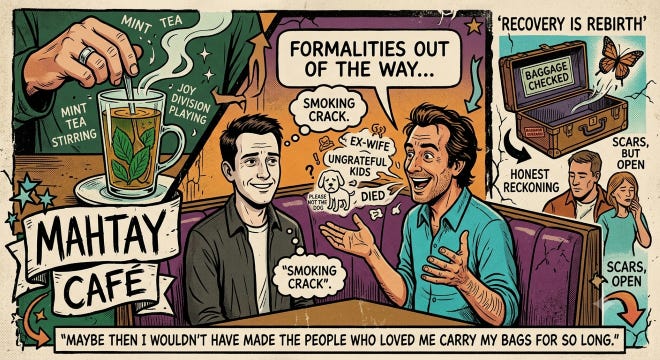
Smoking crack.
Formalities out of the way, my friend proceeds to thoroughly unburden himself. And what a weight it is. He drops his ex-wife on me (“She took everything”). The kids too. (‘Selfish, ungrateful… don’t give a damn about anything.’)
“And my dog…” PLEASE. NOT THE DOG. “… died last week.”
Well, it’s good to see you too.
It will take every drop of my mint tea, many more post-punk classics from the ‘80s and even a sliver of my soul before I rid myself of him. It’s not such a bright day at the Mahtay anymore and I have only myself to blame. Happiness is a beacon. Eventually, someone shows up to explain why the world has wronged them. Including the poor dog.
And for all that, he still has that easy laugh I remember from high school. Jeff! That’s his name. We used to call him The Nose — only because he had a perfectly normal-sized nose. It seemed clever at the time. He still loves his kids too, even if he can’t stop telling me how disappointed he was in them.
The strange thing is, I keep recognizing pieces of myself in Jeff. The certainty. The grievances. The belief that if everyone else would just behave differently, I would finally be okay.
Listening to him, I realize something uncomfortable: I spent years being exactly the kind of person sitting across from me. The difference? Jeff is showing me the person I might have become if I had never looked closely at myself.
As we get older, life’s accumulated losses, disappointments and assorted frictions become heavier to carry. And some people never learn that their baggage is theirs to carry. Eventually, their perspective becomes a closed circuit, admitting less and less light from fresh experience into their world.
One thing they don’t do much is listen. They don’t make room for other perspectives. They don’t wonder if they might be wrong.
And please, God, shut the fuck up.
If you think a drug addict is bad company, try hanging around someone who has never learned to examine themselves. Blah blah me me me. The endless autobiography of someone who thinks their disappointments are the most interesting thing that has ever happened.
But you know who I love talking to?
People who got clean.
Recovery is learning to check your bag at the door.
Of course, they didn’t walk out of the darkness without scars. They’re still carrying the weight of whatever abyss they crawled out of — and whatever monster pushed them into it in the first place.
But they’ve learned not to hand it to someone else.
I think that happens because recovery demands an honest reckoning. You take inventory. You look at what you’ve been dragging behind you. And then, finally, you decide what is worth bringing into the future.
Recovery is rebirth.
And boy, are people who have found their way back good to be around.
Their lives are no longer closed loops. They’ve learned to be curious. They’ve learned to listen. They’re funny. They’re not afraid to cry. They’re open to other ways of living and thinking.
I wish I had gone through it sooner.
Maybe then I wouldn’t have made the people who loved me carry my bags for so long.
It sounds like you walked into an ‘80’s post punk bar and listened to a whole lot of country instead.
Your story is so impactful and hopeful and told with intelligence, wisdom and humour. I hope that your writing about it will one day infiltrate and encourage a wider audience. In the meantime, it's great work and I enjoy it immensely.